

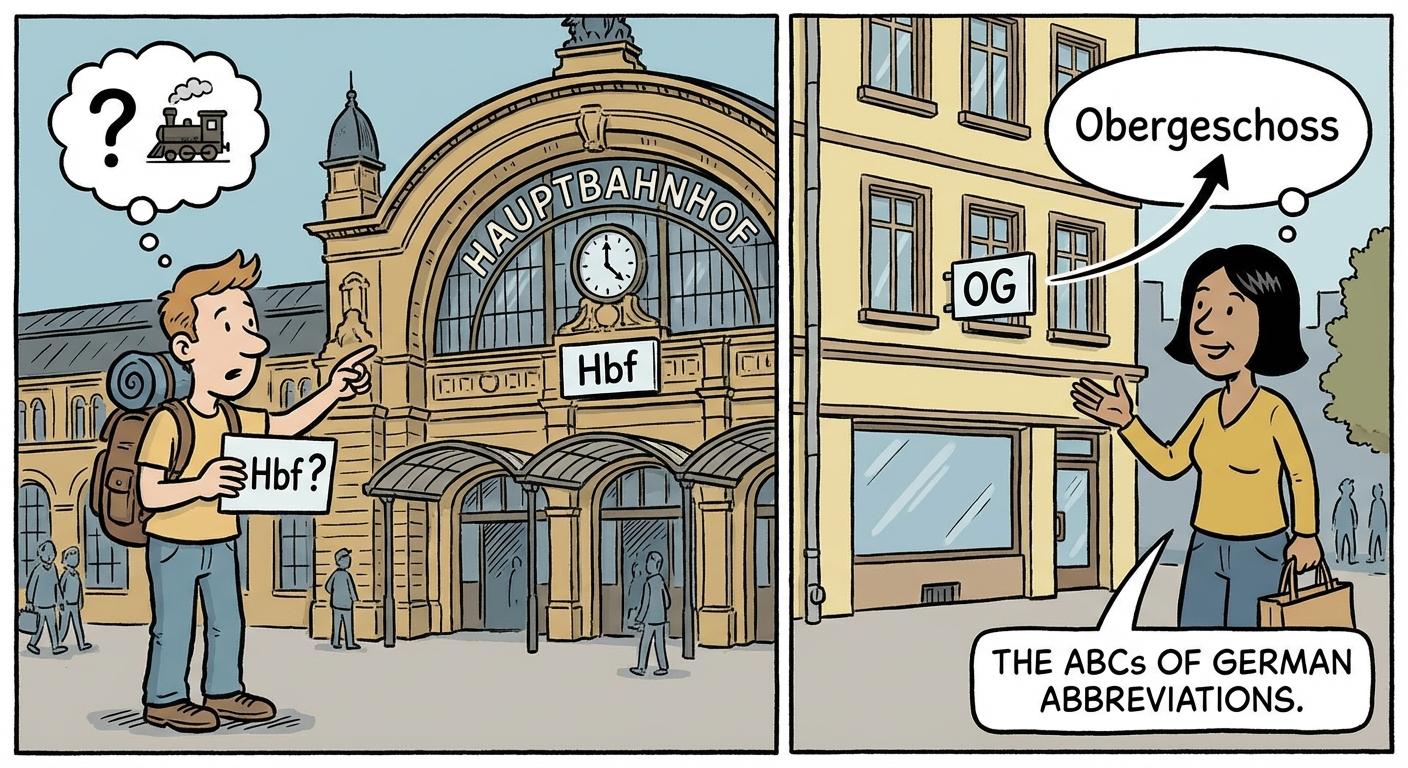
Nearly every language in the world contains abbreviations. Abbreviations are used to transport information faster. They are especially useful where there is little space to write words. Sometimes they serve only to understand things, places and facts faster. But what if you don’t speak the language and don’t understand its abbreviations? There are a lot of abbreviations in German, which I would like to explain to you here. Especially as a Munich bound traveller this knowledge might become handy
WC
also sometimes written: W.C. WC is the abbreviation for Wasser closett (engl. water closet) and means “Restroom” “Toilet”. Signs showing WC will guide you the way to the next toilet.
Gl.
Gl. is the abbreviation for “Gleis” (engl.: track or platform). You will find this abbreviation on train timetables indicating at which platform a train leaves or arrives. With the rise of modern digital timetables, the abbreviation Gl. became more and more seldom.
Opf.
Opf. is the abbreviation for “Oberpfalz” (engl. Upper Palatinate). Upper Palatinate is (simplified) the eastern Bavarian region forming a border to the Czech Republic. Bavaria is devided into 7 different regions one of them is Upper Palatinate.
Hbf.
HBF is the abbreviation for Hauptbahnhof (engl. main station). You will find this abbreviation on public transport vehicles en route to a main or central station. For example Munich Main Station (“München Hbf.”).
Bf.
BF. is the abbreviation for Bahnhof (engl. station). You will find this abbreviation on public trasnport vehicles en route to a specific train station for example Pasing Station (“Pasing Bf.”).
Pl.
Pl. is the abbreviation for “Platz” (engl. square/plaza). You will find this abbreviation nearly everywhere when it comes to street signs or adresses. This abbreviation is usually used within a name. For example: “Marienpl. – Marienplatz.
Bay.
also written Bayer.
Bayern or Bayerisch(e/s)
Bay. is usually the abbreviation for “Bayern” (engl. Bavaria). Bayer. is the abbreviation for “Bayerisch/e/s” meaning “Bavarian”.
Str.
Str. is the abbreviation for “Straße” (engl. street). You will find this abbreviation nearly everywhere when it comes to street signs or adresses.
This abbreviation can be used within a street name. For example: “Maximilianstr.” or “Neuhauser Str.”
Obb.
bb. is the abbreviation for “Oberbayern” (engl. Upper Bavaria). Upper Bavaria is (simplified) the region around Munich up to the alps. Bavaria is devided into 7 different regions one of them is Upper Bavaria.
CH
Can be found on motorway signs in Germany and Austria, but also on some cars.
CH is means “Confoederatio Helvetica” the Latin term for Switzerland. Motorway signs showing CH lead to the swiss border.
By the way: You can also find “A” for Austria, “I” for Italy and “CZ” for Czech Republic on Motorway Signs.
MUC
MUC is the International Air Transport Association (IATA) code for Munich International Airport. But MUC is often also used as abbreviation for Munich in general. Also new car plates of Munich show MUC.
Nbg.
Nbg. is the abbreviation for “Nürnberg” (engl. Nuremberg), the second largest city in Bavaria, famous for its Christmas Market and medieval old town but also know for its dark past during the Third Reich.
OG
Can be found in stairways and elevators. OG is the abbreviation for “Obergeschoß” and literally means “upper floor” – the floor above ground level. If a building has more levels, these are numbered (1.OG, 2.OG, 3.OG etc.).
UG
UG is the abbreviation for “Untergeschoß” and literally means “below floor” – the floor below ground level/basement. If a building has more levels underground, these are numbered (1.UG, 2.UG, 3.UG etc.).
In old buildings you can sometimes also find the term KG – Kellergeschoß (basement level).
WLAN
WLAN is not really an abbreviation as it is used as word in German (spoken: weeh-luhn). It actually should abbreviate the term “Wireles-LAN”, a wireless internet connection. English speakers would rather say “WIFI”.