

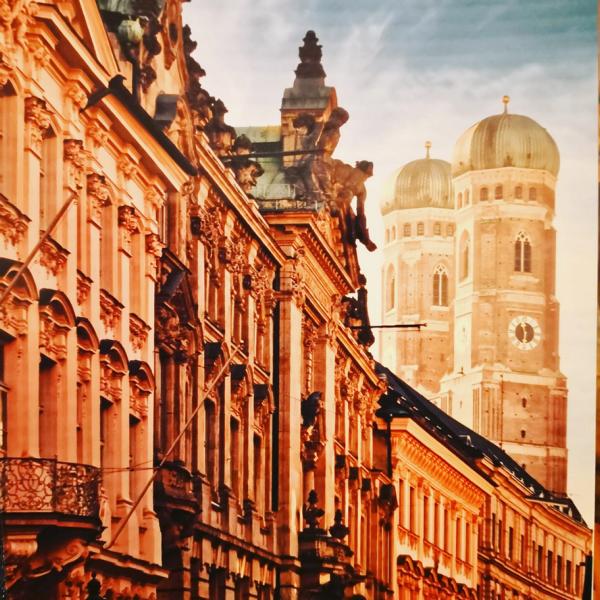
The Frauenkirche in Munich is one of Europe’s most iconic Gothic cathedrals and the spiritual heart of Bavaria’s capital. With its distinctive twin onion domes towering about 100 meters above Marienplatz, the Frauenkirche is instantly recognizable and has been a defining symbol of Munich’s skyline since the 15th century. Whether you’re drawn by faith, fascination with medieval architecture, or simply seeking awe-inspiring beauty, this magnificent cathedral offers an unforgettable experience.

A Quick Look at the History
Construction of the Frauenkirche (Church of Our Lady) began in 1468 under the patronage of Duke Sigismund, and the cathedral was completed in just 20 years – a remarkable feat for such an ambitious architectural undertaking. The church was built to replace an earlier Romanesque church and immediately became a testament to Munich’s growing wealth and importance during the late medieval period. Fin fact: At that time the chirch was way too big for a small city like Munich.
But what makes the Frauenkirche truly exceptional is its innovative design. The architect, Jörg von Halsbach, created a hall church with an unprecedented width and openness, making it one of the largest hall churches of its time. The interior space feels expansive and light, creating a sense of spiritual uplift that has moved millions of visitors over nearly 600 years.
The iconic twin domes, added in the early 16th century, were inspired by Italian architecture and have become synonymous with Munich itself.
What to Discover at Frauenkirche

Step inside the Church of Our Lady and you’ll be enveloped by an atmosphere of serene grandeur. Despite its vast interior, the cathedral feels intimate – a place where thousands of visitors can walk quietly, lost in contemplation.
One of the most striking features is the colored glass windows. While the originals were destroyed during World War II, the modern replacements beautifully capture light and create a meditative ambiance throughout the cathedral. The interplay of colored light on the stone pillars is particularly magical during late afternoon when the sun streams through the western façade.
The choir stalls are masterpieces of medieval craftsmanship, intricately carved with Gothic detail. The high altar, a more recent addition from 1858, dominates the eastern end of the cathedral and draws the eye toward the spiritual center of the sacred space.
Don’t miss the Devil’s Footprint right after the entrance. According to legend, when Jörg von Halsbach completed the cathedral, the devil appeared and was so frustrated by the architect’s achievement that he stamped his foot on the ground – supposedly leaving a scorch mark that remains visible today. Whether you believe the legend or not, it’s a charming piece of Munich folklore.
Beneath the cathedral lies the impressive crypt, where numerous Munich dignitaries and members of the Bavarian royal family are buried.
The Domes and Panoramic Views
For the more adventurous visitor, climbing the south tower is an absolute must. The journey up involves 89 steps and a rather narrow elevator, but the reward is breathtaking: a panoramic view of Munich that extends to the distant Alps on clear days. The views are particularly stunning during winter in the so called golden hour – late afternoon when the city is bathed in warm light (last elevator up at 4:30 pm). The entrance costs 7.50 EUR per adult)
A Living, Breathing Community
While the Frauenkirche is undoubtedly a major tourist attraction, it remains first and foremost an active Catholic cathedral. Regular masses are held daily, and the spiritual energy of the space is palpable. Visitors are warmly welcomed to observe services or simply sit quietly in contemplation. The cathedral hosts important religious ceremonies, concerts, and special events throughout the year, maintaining its role as the living center of Munich’s faith community.
The connection between the Frauenkirche and Munich’s identity is profound. For centuries, locals have regarded the cathedral as a protective symbol, and many traditional Bavarian customs and celebrations center around it. During the Christmas season, the cathedral’s surroundings transform into a magical market, and the sight of the twin domes illuminated against the winter sky is truly enchanting.
Opening Times
The Frauenkirche is located at Frauenplatz, connected to Marienplatz – the heart of Munich’s old town by narrow alleys. You can reach Frauenkirche by U-Bahn (subway) or S-Bahn (urban rail). Alight at Marienplatz station. Most major attractions are also within walking distance. Admission to the cathedral is free except if you want to climo the south tower. The north tower is not open to public.
The cathedral is typically open daily from 8:00 AM to 8:00 PM (hours may vary seasonally and for special events). Modest dress is appreciated , especially during summer – cover your shoulders and knees as a sign of respect for the sacred space. Photography inside is generally permitted for personal use, but flash photography is not allowed.
Plan to spend at least 30 minutes to an hour exploring the cathedral at a leisurely pace. If you intend to climb the south tower, add another 30-45 minutes.
Visit early in the morning or late afternoon to avoid the largest crowds, particularly during summer months. The cathedral is less crowded on weekdays and off-season. For a truly special experience, attend an evening service when the cathedral is softly lit and filled with hymns and prayers.
Opening Times
Church
-
daily8:00 AM - 8:00 PM
South Tower
-
Mon - Sat10:00 AM - 5:00 PM
-
Sun/national holidays11:30 AM - 5:00 PM
-
Last entrance4:30 PM
Good to know for Frauenkirche
- See the Devil’s Footprint near the main entrance
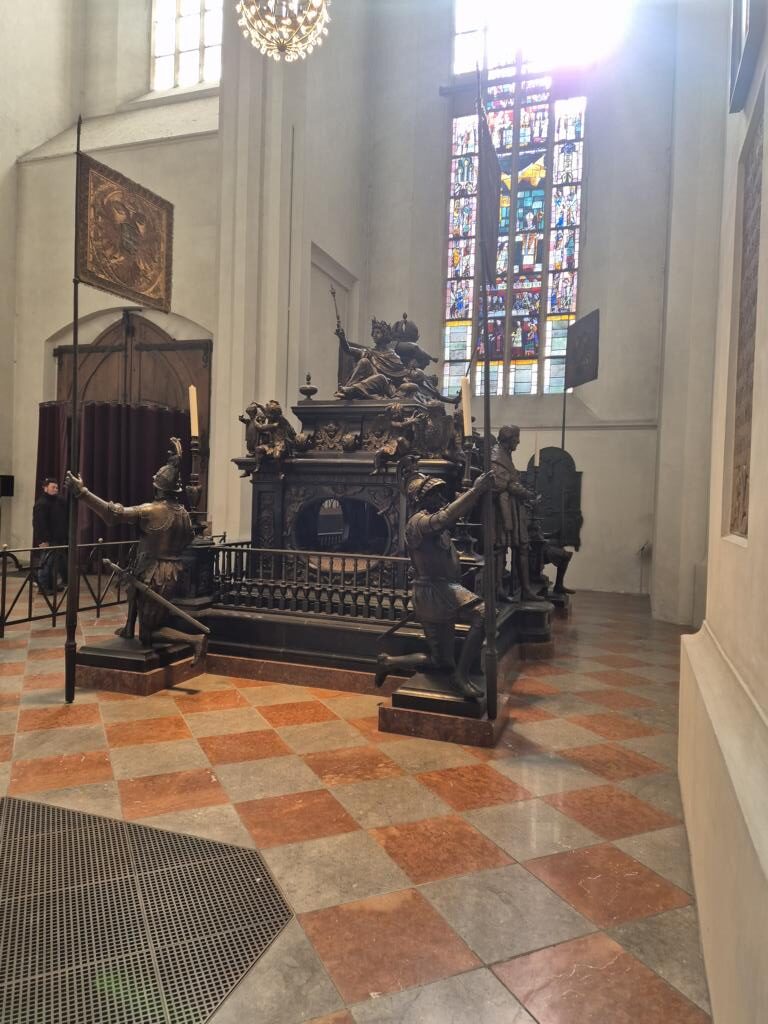
- See the Kenotaph – a monument for Emperor Ludwig of Bavaria, built in 1622.
- See the “Automatenuhr” one of the first clocks in Munich, dating back to at least 1568.
- Fun Fact: Munich citizens gave the two towers names. Meet “Stasi” (short for Anastasia) and “Blasi” (short for Blasius)
- The height of the towers is not exactly 100 meters. It is 98,57 meters (north tower) and 98,45 meters (south tower)
- A city law forbids building taller buildings than the towers of the Frauenkirche (at least in the inner city)
- compared to other catholic churches in Bavaria, the Frauenkirche feels “empty”. This because many interior items were destroyed during World War II
Conclusion
The Frauenkirche is far more than an architectural landmark – it’s the soul of Munich. Its soaring spaces, magnificent Gothic design, and the iconic twin domes that crown the skyline embody centuries of faith, craftsmanship, and Bavarian identity. Whether you’re climbing the tower for panoramic views, sitting quietly in prayer or reflection, or simply admiring the architectural brilliance, the Frauenkirche will leave you moved and inspired. This is a cathedral that transcends religious boundaries – everyone who visits feels the weight of history and the timeless beauty that makes Munich special. A journey to Munich is incomplete without experiencing the majesty of the Frauenkirche.